- Computyper 5005
- Friden-Singer Corp.
- Nijmegen, Gelderland, NL
- March 1968
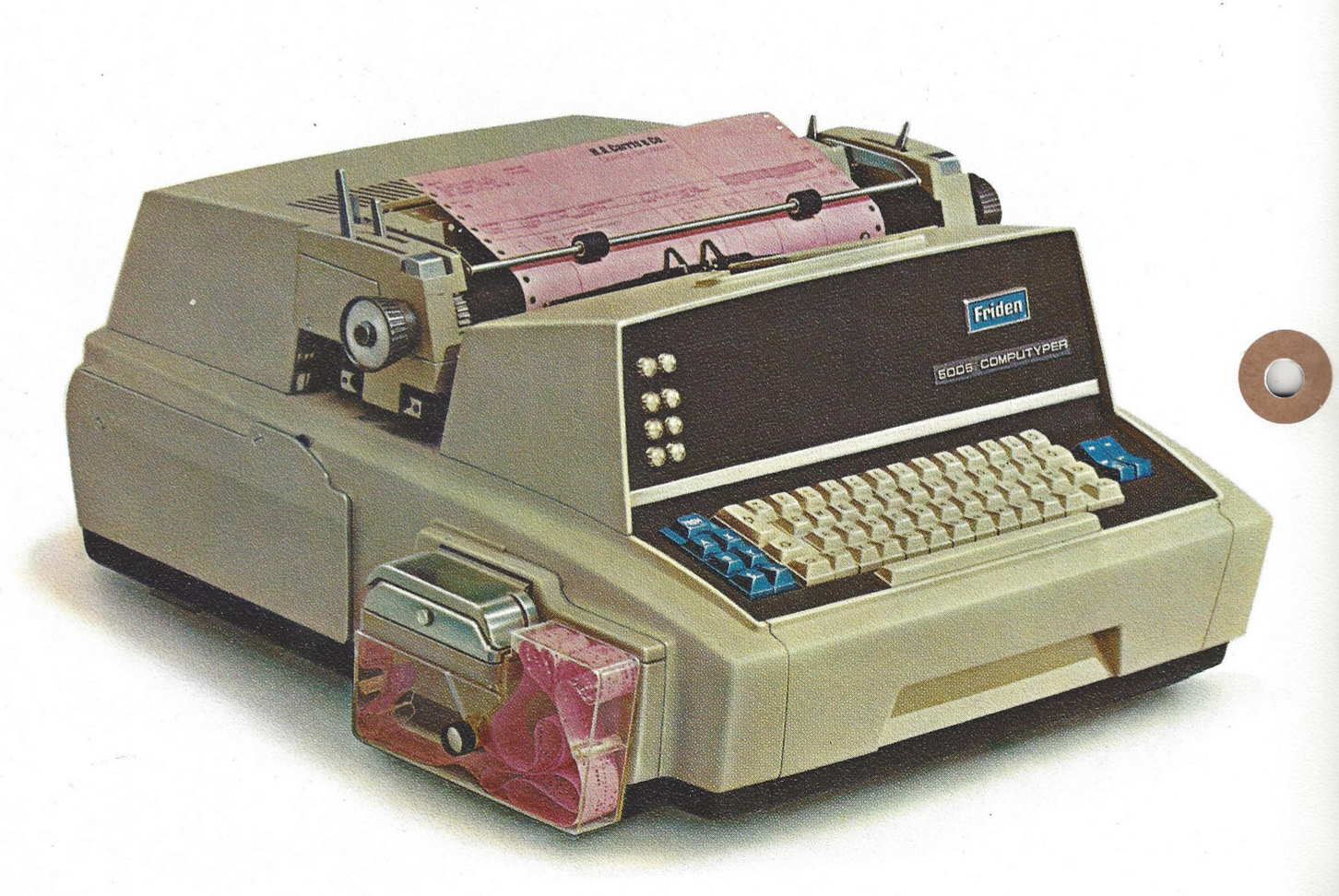
| - This is one of the most intriguing early small computer systems I have yet encountered. This system was marketed as a lowly "billing machine;" however, it was really capable of much more than that. Prototyped in 1967 and released in early 1968, the Friden Computyper 5005, produced under the Singer Corp., was a fully capable desktop computer. However, the compact form factor did not follow to its weight - according to specification, it weighed 45 kg, or about 100 pounds! Internally, it contained a standard mechanical typewriter, power supply and delay line circuits, and a block of densely stacked circuit boards filled to the brim with ICs. Yes - besides its compact form factor, this tiny machine was one of the first to implement its logic entirely with LSI circuitry! The processor built out of these is akin to the processor unit of an early desktop programmable calculator. But make no mistake - this system was not at all limited to numbers. As evidenced by the technical manual, it was capable of taking automatic input from the keyboard, output to the printer, string manipulation, basic arithmetic, register storage and retrieval, and most importantly, fully implemented conditional branching, making it fully Turing-complete and closer to something like the Datapoint 2200 than the HP 9100. It also had a proprietary storage format of paper tape rolls enclosed in clear plastic cartridges, making program loading very simple and fast. An optional tape punch was offered as well, so you could write programs on the same system you ran them on. Apparently, these systems were manufactured in Friden's plant in Nijmegen, a city in the Netherlands, and first sold in Europe, then the UK, and then finally America. By September 1969, systems were being sold as far as Australia!
Sources:Friden 5005 Computyper Technical Manual, c. 1968; [link]. Data Processing, March/April 1968, p. 78-81; [link]. The Bulletin (Australia), September 13, 1969, p. 5; [link].
| 

The CPU cage of a unit
manufactured circa 1969.
- Sycor 302
- Sycor, Inc.
- Ann Arbor, Michigan, USA
- July 1968 (marketed)
- February 1969 (first delivery)
| - The Sycor 302 is probably the most unfairly unknown computer system of the 1960s. I'm sure anyone interested in the roots of desktop computing has often heard the story of the Datapoint 2200 released in 1970: the "first desktop computer" or "first PC" - as far as writing entire books titled "The Texans Who Invented the Personal Computer"! Many books, encyclopedias, and otherwise reliable sources have done this story to death and all claim the 2200 as the inception of the desktop computer or intelligent terminal.
However, what is almost always omitted is that this is not true at all. In fact, Datapoint spent nearly a decade in litigation with a small Midwestern company who had patented this exact system years prior
Sources:Electronics, January 3, 1973, p. 44; [link]. Intel Micro Computers, April 1973, p. 3; [link].
| 
| - MYCRO-1
- Data Industri A/S
- Oslo, Norway, EU
- December 1974
| - To quote its first advertisment, "We've developed a microcomputer that's ahead of its time." And they were completely right! Released just one week before the Altair was announced, the MYCRO-1 was a single-board microcomputer using the Intel 8080, that was released by Norsk Data Industri of Norway in late 1974 and first advertised in the December 12, 1974 issue of Electronics. Their tagline read: "Others are trying to develop microcomputers like these. Ours is for sale now." This pace of R&D and production was an incredible feat for the time, especially since this machine was built in Europe! The computer ran its own proprietary operating system, MYCROP. In 1975, Data Industri introduced an add-on floating-point and I/O package. By 1977, a version based on the Zilog Z80 was introduced, which could run standard CP/M.
Sources:Electronics, December 12, 1974, p. 21; [link]. Electronics, December 26, 1974, p. 49; [link]. MYCRON-1 Microcomputer (brochure), A/S Mycron, 1975; [link].
| 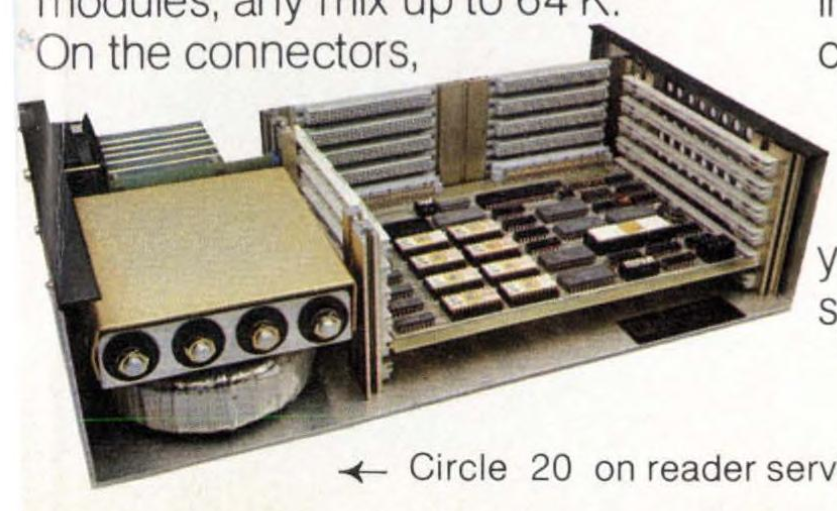
(Computer is contained on the
one board in occupied slot)
| - Seiko S-500
- K. Hattori & Co., Ltd.
- Chuo, Tokyo, JP
- March 1972
| - This is a very interesting machine with an even more interesting story. Apparently, around 1970, SEIKO (of wristwatch fame, aka K. Hattori & Co., Ltd.), was looking for a single-chip solution for an upcoming calculator. This would succeed their S-300 programmable calculator, released in 1968 as a clone of the 1965 Olivetti Programma 101. After SEIKO learned of another company's contract with Intel to develop the 4004 for the Busicom 141-PF printing calculator, they followed suit. In November 1970, SEIKO agreed to finance and aid Intel in developing the 8008 (then termed the 1201). Since Daniel Alroy of Q1 had already settled Datapoint's original contract for the 1201, Intel was green-lit to be subcontracted by SEIKO. Because of this, the Seiko S-500 desktop programmable calculator was able to be released in March 1972, prior to Intel's public release of the 8008, which occurred a month later when their exclusive contract was terminated. Besides its intriguing origins, the Seiko S-500 is a curious piece of equipment in its own right. Firstly, unlike most other programmable calculators of the era, the S-500 was a true general-purpose computer in disguise. If attached to a teletype, it could be used as a complete computer system! Intended mostly for business and industry, the S-500 was released in three models: the N20 at ¥1,550,000, the N30 at ¥1,700,000, and the N40 at ¥1,890,000. Additionally, an optional thermal receipt printer attachment was also available (see image). The earliest known ad for the system is the one shown to the right, from the May 9, 1972 issue of the Japanese newspaper The Nikkei. The S-500 was also apparently distributed in France in 1973 by Tekelec. Intel prominently featured the S-500 in their advertising as early as January 1973.
Sources:The Nikkei, May 9, 1972; [link 1], [link 2]. hardoff.net (in Japanese), Seiko S-500; [link]. diarywind.com (in Japanese), Early Microcomputer Advertisements [No. 1]; [link]. silicium.org (in French), Seiko S-500; [link].
| 
(Processor is contained in
the larger unit to right)
| - Star System 4
- Comstar Corp.
- Edina, Minnesota, USA
- February 1972
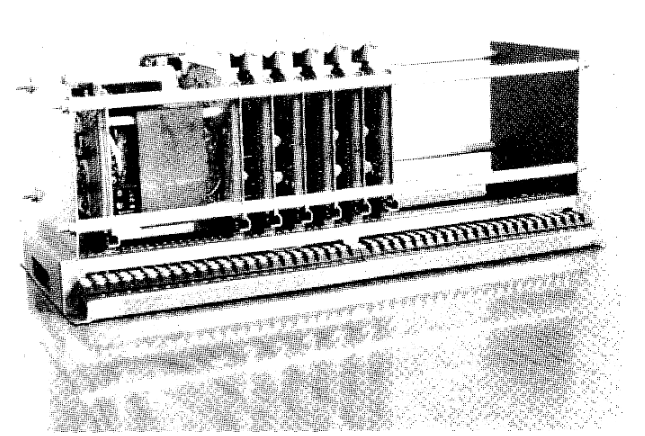
| - One of the earliest (if not the earliest) microcomputer systems ever devised and put to market, the Comstar Star System 4 was based on the Intel 4004 (which had released just 2 months prior), and first sold in February 1972, preceding even the above SEIKO and other systems by many months. Like the 1973 Micral N (see here) and many other early microcomputers, this system was primarily intended for industrial automation and control systems in factories. The system was manufactured and distributed by Comstar Corp. of Edina, Minnesota, a supplier of industrial and scientific electronics systems. By November 21, 1972, they had published an interim manual for the Star System 4. At just $995 for a complete entry-level system, this was possibly the first microcomputer to dip into the sub-$1,000 range. By July 1973, 300 Star System 4s had been installed. In 1974, the Warner & Swasey Company of Cleveland, Ohio acquired Comstar Corp., and continued manufacturing revised systems, such as the Comstar System 4A based on the Intel 4040, throughout 1975 and onwards.
Sources:Interim Comstar Star System 4 User's Manual, November 21, 1972; [link]archive.org, Comstar Computer Systems documents; [link]. All About Minicomputers, Datapro, July 1973, p. 19; [link]. Internet Scripophily Museum of Computing, The Warner & Swasey Company; [link].
|  . .
| - Seiko 7000
- K. Hattori & Co., Ltd.
- Chuo, Tokyo, JP
- February 1974
| - The follow-up to the S-500, the Seiko 7000 L-8 desktop programmable calculator was based on the Intel 8080 and introduced in February 1974. Unfortunately, this system is even more sparsely documented than the already obscure S-500. Presumably, the reason this system was released prior to the 8080's public release as a separate product is likely due to SEIKO's previous ties to Intel.
Sources:calcuseum.com, Seiko 7000; [link]. diarywind.com (in Japanese), Early Microcomputer Advertisements [No. 1]; [link].
| 
| - PDC-8
- Nippon Sys. Dev. Co., Ltd.
- Takarazuka, Hyogo, JP
- November 1973
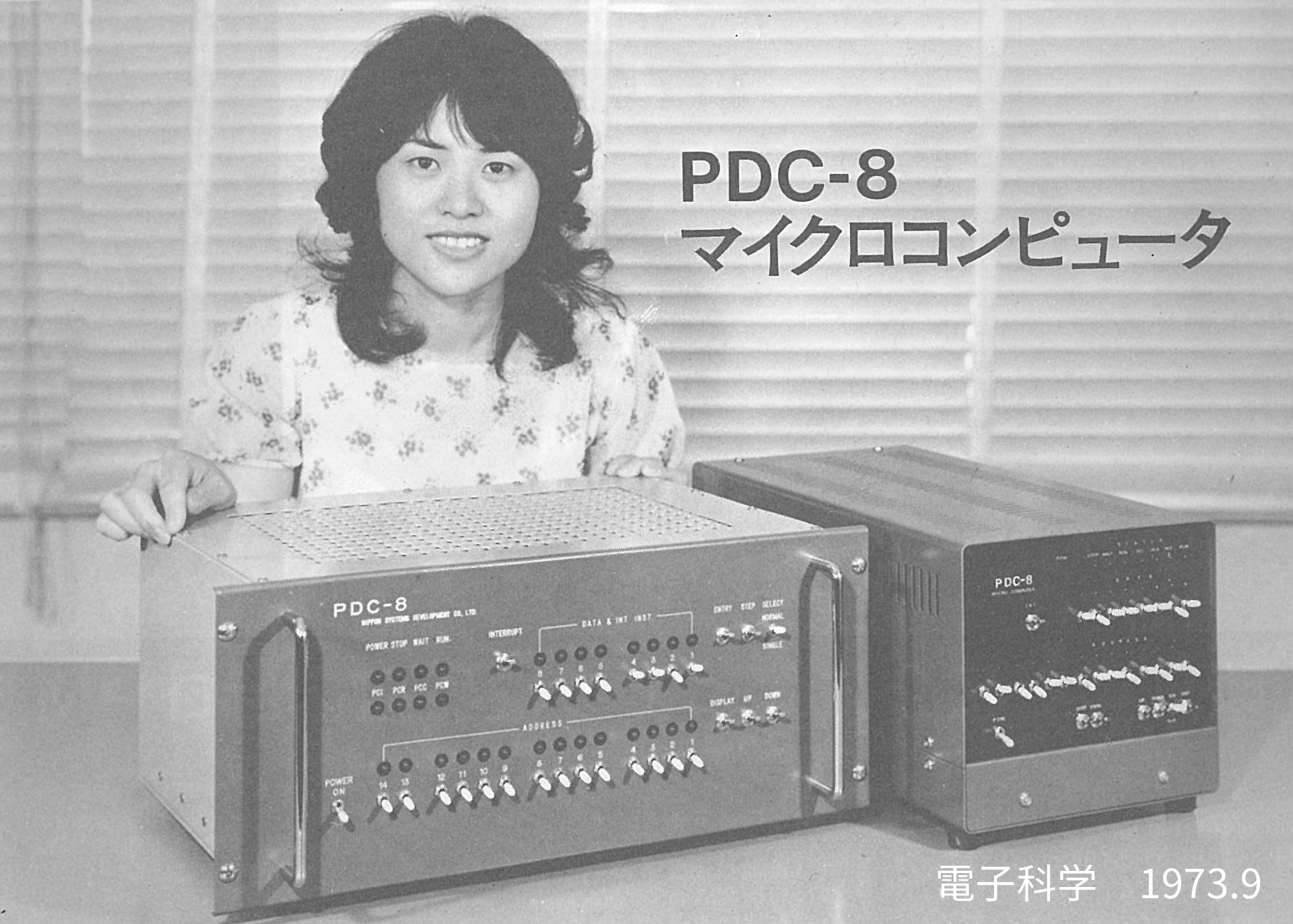
| - Yet another forgotten early system from Japan, the PDC-8 is a microcomputer based on the Intel 8008, released by Nippon (Japan) System Development Co., Ltd. in 1973. The image to the right shows its depiction in the September 1973 issue of the Japanese magazine Electronic Science. According to the company, the first production system was delivered to the Tokyo Institute of Technology in November 1973. Unlike some of the above systems, this claim can be corroborated - that exact unit still survives, and is still in possession of the Institute! Moreover, this unit even specifies a production datecode of 1973-11, a serial number of 0031, and a model number of 201.
Sources:The MZ-80 Computer Development Story (in Japanese), Machines Superior to the Altair 8800; [link]. SystemGear (in Japanese), Company History; [link].
| 
| - PDC-80
- Nippon Sys. Dev. Co., Ltd.
- Takarazuka, Hyogo, JP
- c. summer 1974
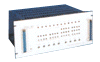
| - The follow-up to the PDC-8, the PDC-80 microcomputer was based on the Intel 8080 and introduced in the summer of 1974. Unfortunately, like the Seiko 7000, there is almost no information about this system online. The low-quality image to the right is the only one known to be of this system, and is from SystemGear's old website's history page. There is at least one account of someone using this system to write a floating-point BASIC interpreter in the summer of 1974.
Sources:The MZ-80 Computer Development Story (in Japanese), Machines Superior to the Altair 8800; [link]. SystemGear (in Japanese), Company History; [link].
| 
| - SORD SMP80/20
- Sord Computer Corp.
- Chiba, Japan
- May 1974
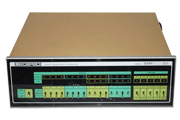
| - The SORD SMP80/20 was a microcomputer based on the Intel 8080 introduced by the Sord Computer Corp. of Chiba, Japan in May 1974. Despite often (incorrectly) being credited as Japan's first microcomputer, as you can see by the above systems, this is not the case. The enclosure gives it the appearance of a rather unremarkable clone of a Data General Nova or some other minicomputer.
Sources:IPSJ Computer Museum, SMP80/x Series; [link]
| 
| | Other Forgotten Small Computers...
| |
![[link 2]](https://web.archive.org/web/20181206151744im_/http://radioc.web.fc2.com/column/pcad/ad/img/seiko500.jpg)