The following is a direct copy of the text of Alroy's account of Q1 with minor formatting fixes,
originally taken from an archive of his website, philon.net (now defunct), as of June 2004.
Most photographs have been moved to a gallery at the bottom of this page.
Daniel Alroy.
In 1970, while Alroy was philosophy student at the City University of New York, he was offered a quarter of a million dollars by a group of private investors, headed by James Walden, of Philips, Appel and Walden, to form a new computer company. The Company, Q1 Corporation, then developed and manufactured the world first microcomputer system, which was delivered to Litcom, a Division of Litton Industries, on December 11, 1972. That system utilized the Intel 8008, which was introduced in April that year.
The 8008 was the first 8-bit, single-chip, microprocessor, and was the first member of what has become the Pentium series. In 1973, these systems were also the first microcomputers to be installed in Asia (Hong Kong and Taiwan) and Europe (Germany). That year Nixdorf Computer of Paderborn, Germany, provided funds for the development of the next generation systems based on the Intel 8080 processor.
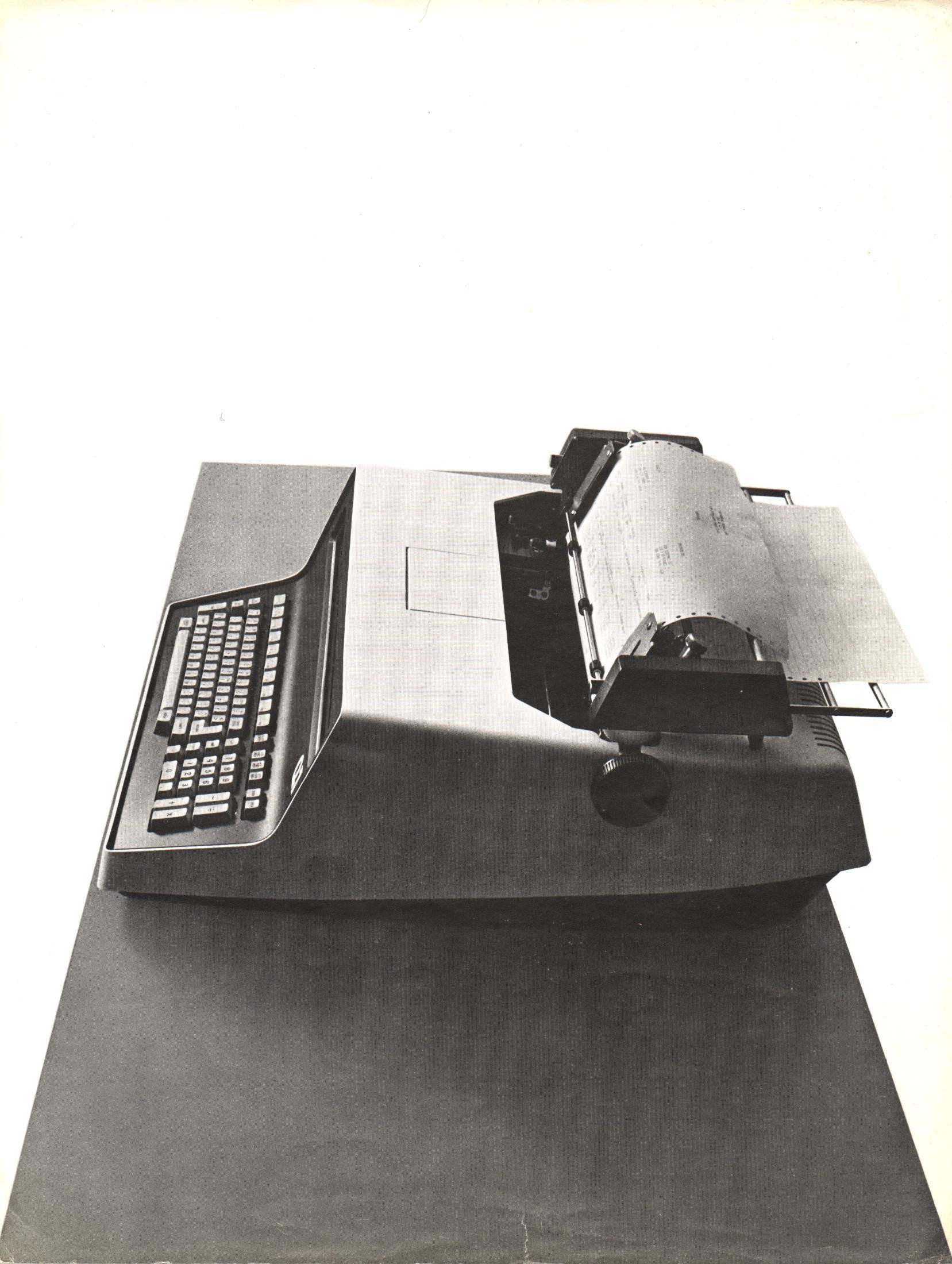 Photograph of the desktop console
of the world's first microcomputer
system. It utilized the Intel 8008
single-chip microprocessor.
Photograph of the desktop console
of the world's first microcomputer
system. It utilized the Intel 8008
single-chip microprocessor.
The computer system was developed and manufactured by Q1 Corporation, and delivered to Litton Industries, Litcom Division, in Melville, New York, on December 11, 1972.
In 1973, Q1 microcomputer systems were installed in Europe (Germany) and Asia (Hong Kong).
The Q1 System remained the world's only self-contained, general purpose microcomputer system until Intel introduced the 8080 second generation microprocessor.
The Advent of the Microcomputer Era: An Eyewitness Account
In October, 1969, Computer Terminal Corporation (later renamed Datapoint) of San Antonio, Texas, raised $4 million through an Initial Public Offering. The underwriters were Phillips, Appel & Walden (PAW), a Wall Street firm, and Hambrecht & Quist of San Francisco. At the time I was the high technology consultant to PAW, as well as a doctoral student in Philosophy at the City University of New York. Before the IPO, I went to San Antonio to evaluate Datapoint. They had designed a terminal, the Datapoint 3300, which was intended to be used in a remote computing environment. My assessment of the 3300 was influenced by my evaluation, a few months earlier, of Advanced Memory Systems, of Sunnyvale, California prior to their IPO by Philips, Appel and Walden in April 1969.
Advanced Memory Systems was the first company to develop a semiconductor chip with 1,024-bit random access memory (RAM). Recall that it all began with the invention of the transistor at Bell Telephone Laboratories in 1947. In 1957, Robert Noyce and Jack Kilby independently implemented an entire transistor circuit as a single semiconductor chip: The integrated circuit (in 2000 Jack Kilby was awarded the Nobel Prize in Physics for that achievement). The 1,024-bit RAM represented a thousand-fold increase in the number of the transistors on a single chip.
The chip size and cost remained substantially the same. Hence, the increased density translated directly into a thousand-fold decrease in the cost per bit. It was evident that the semiconductor technology is the engine that drives the computer revolution. Evaluating AMS required that I estimate the future rate in the increase in the transistor density per chip. I sought the view of Professor Carver Mead, who was at the California Institute of Technology at the time. After addressing the physical limits of such increase, he suggested that it will continue at somewhat slower rate. This trend led me to conclude that local computing would replace remote computing, and that point-of-use computing would replace locally shared computing.
I did not have the competence to determine whether transistor density at that time (1,024-bit RAM on a chip of about 4 square millimeters) was sufficient for implementing a basic CPU design on a single chip, but it was intuitively clear that with the increased density of transistors per unit-area, a single-chip CPU is unavoidable. It is against the background that I evaluated the Datapoint 3300 terminal, which was designed for remote-computing environment.
During my initial visit to San Antonio, Texas, I conveyed to the VP for R&D, Austin (Gus) Roche, my view that I anticipated that remote computing would be short-lived, and pointed out the implications for their so-called "dumb" terminal. I urged him to put a central-processing-unit (CPU) in the point-of-use and convert it into an independent work station. Gus accepted the future need to incorporate a CPU at the point-of-use. Impressed with the technical, managerial, and manufacturing capabilities of the company, I recommended that PAW go ahead with the IPO. A month prior to the public offering, the company began the development of Datapoint 2200. Then in November that year, the CPU design was given to Victor (Vic) D. Poor and Harry S. Pyle, who were at the time outside consultants to Datapoint. While I had communication with neither at that time, they planned, from the outset, to have the CPU fit on a single chip. In December, 1969, Datapoint asked Intel and Texas Instruments (TI) to implement the CPU design on a single chip. Intel agreed, and initially called the processor 1201. It was later renamed 8008. Intel's main business at that time was to design and manufacture of 1,024 bit random access memory (RAM). Intel also undertook to design a programmable calculator chip-set for Busicom of Japan (later renamed the 4004). When Intel realized that the capacity of the technical staff was insufficient for the development of both products at the same time, the development of the 8008 was shelved.
Datapoint then let Texas Instruments (TI) implement the design on a single microprocessor chip. TI promptly filed for a patent application on such implementation. But after TI encountered yield problems, Datapoint implemented the 2200 CPU using random logic. (Malone, 1995; Noyce and Hoff, 1981; Poor, 1996). The 8008 led first to the design of the 8080, and eventually to the Pentium processor. Naturally, there was no design commonality between the 4004 and the subsequent microprocessor family. But, faced with the fact that the logic design of the 8008 was made by Datapoint, and its initial chip implementation was covered by TI's patent application, Intel declared the 4004 to be the first microprocessor. As soon as I heard that Intel stopped the development of the 8008, I asked to meet with Dr. Noyce. I expressed to him my view that the 4004 was unsuitable for general purpose use because, among other things, its 4-bit-wide word was insufficient to represent alphabetical characters. I conveyed to him my conviction that an 8-bit single chip microprocessor would revolutionize the computer industry. I urged him to resume the project. Dr. Noyce agreed to do so after completing the 4-bit chip-set for Busicom. He indicated the need to obtain a release from Datapoint for Intel to proceed with the project on its own. I told Dr. Noyce that I would talk to Phil Ray, the president of Datapoint about granting the needed release. I returned to San Antonio and met with Phil Ray, who then agreed to provide Intel with the requested release.
Datapoint's contribution to the advent of the microprocessor era was virtually unknown. I felt that this ought to be corrected. In 1975, I was scheduled to chair the opening session at the IEEE International Conference in New York, which was titled "The Microcomputer Revolution." I asked Gus Roche to present a paper on Datapoint contribution. He agreed. However, shortly before the Conference, he died in a car accident.
Prior to Datapoint's public offering, I discussed with Jim Walden, the Managing Partner of Phillips, Appel & Walden, my view that the Datapoint 3300 was based on flawed assumptions. His response was to suggest that if I could design a better product, I should do so, and that he would get together some private investors and provide me with seed capital. As a result, Q1 Corporation was formed. The computer system I set out to develop was based on two assumptions. The first relates to semiconductor technology. It was assumed, as suggested before, that there would be a continued rapid increase in the number of transistors per unit area, and a corresponding decline in the cost-per-transistor. From this, I concluded that that there would be a trend away from remote, and toward local, computing; and, in local computing, that there would be a shift from shared minicomputers to having a computer at each point-of-use.
The second system design assumption borrowed from the philosophy of science: i.e. that a major new theory is typically characterized by:
The CPU is a general-purpose computer. In contrast, in a computer system this general-purpose character is lost to limited-purpose peripherals and software. My aim was to strive toward making a general-purpose system (Alroy 1978). Such a general-purpose design would:
* In 1973, two limited-purpose products that utilized the 8008 were introduced: In May 1973 Micral, in France, introduced a special-purpose process controller; and in the fall, Jonathan Titus offered the Mark-8, an 8008 assembly-kit for the hobbyist market (Titus 1974). Neither product was, nor intended to be, a self-contained, general-purpose computer system.
Dr. Ron Sommer, who had recently joined the Company, arranged a meeting with the Nixdorf Computer Company in Paderborn, Germany. Subsequently, Nixdorf Computer paid Q1 $40,000 per month for a ten-month period in exchange for know-how (Electronic News, June 18, 1973). This funded the development of the Q1 Lite microcomputer system, which utilized the 8080 microprocessor. At that time, the National Aeronautic and Space Administration (NASA) was looking to install computer systems in their Space Centers. Based on the study and recommendation of the Computer Science Corporation, Q1 Lite systems were installed in all eleven NASA bases.
Running a computer company was a full-time job, and I had to drop out of the doctoral program. Still, I found myself preoccupied with theoretical questions that were unrelated to the work of running a computer company. I therefore intended to return to my primary interests, and began looking for someone to take my place. An opportunity to step down came in 1979 after the National Enterprise Board, an entity of the British Government, invested $11 million in a joint venture with the Company, under which they manufactured our equipment in the UK for marketing in Europe (Electronic News, August 20, 1979).
References
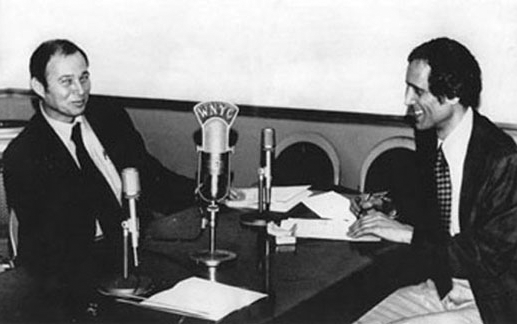
Daniel Alroy comments on the Microcomputer Revolution at the opening session of the 1975 International IEEE Conference, which he organized and chaired.
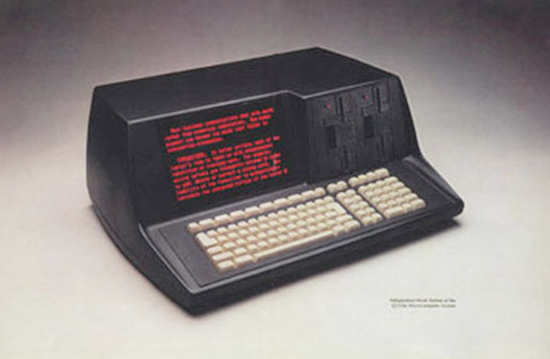
The Q1 Lite, which was installed in all eleven NASA bases. It utilized the Intel 8080 second generation microprocessor.
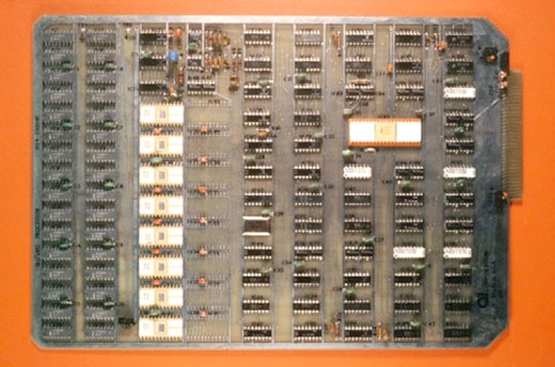
A printed circuit board of the Q1 Lite microcomputer system.
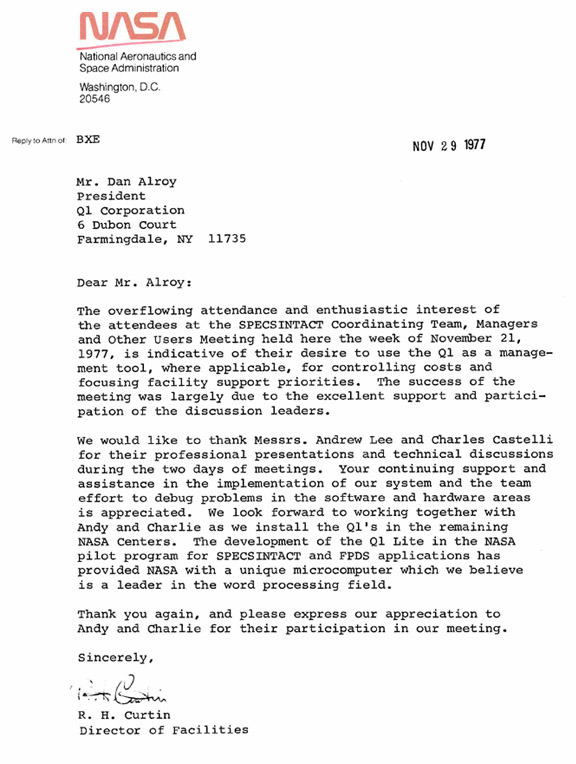
A sophisticated customer reports on its experience with the Q1 Lite.
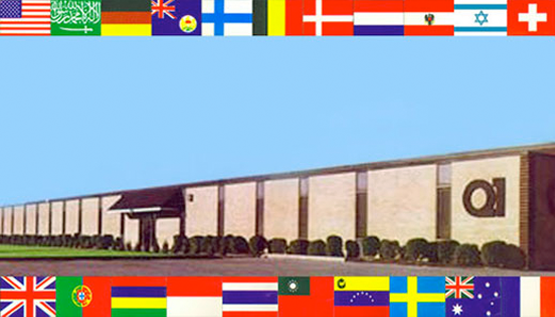
The Q1 facility in Hauppauge. The flags indicate some of the countries where Q1 computers were installed.
In 1970, while Alroy was philosophy student at the City University of New York, he was offered a quarter of a million dollars by a group of private investors, headed by James Walden, of Philips, Appel and Walden, to form a new computer company. The Company, Q1 Corporation, then developed and manufactured the world first microcomputer system, which was delivered to Litcom, a Division of Litton Industries, on December 11, 1972. That system utilized the Intel 8008, which was introduced in April that year.
The 8008 was the first 8-bit, single-chip, microprocessor, and was the first member of what has become the Pentium series. In 1973, these systems were also the first microcomputers to be installed in Asia (Hong Kong and Taiwan) and Europe (Germany). That year Nixdorf Computer of Paderborn, Germany, provided funds for the development of the next generation systems based on the Intel 8080 processor.
Photograph of the desktop console
of the world's first microcomputer
system. It utilized the Intel 8008
single-chip microprocessor.The computer system was developed and manufactured by Q1 Corporation, and delivered to Litton Industries, Litcom Division, in Melville, New York, on December 11, 1972.
In 1973, Q1 microcomputer systems were installed in Europe (Germany) and Asia (Hong Kong).
The Q1 System remained the world's only self-contained, general purpose microcomputer system until Intel introduced the 8080 second generation microprocessor.
The Advent of the Microcomputer Era: An Eyewitness Account
In October, 1969, Computer Terminal Corporation (later renamed Datapoint) of San Antonio, Texas, raised $4 million through an Initial Public Offering. The underwriters were Phillips, Appel & Walden (PAW), a Wall Street firm, and Hambrecht & Quist of San Francisco. At the time I was the high technology consultant to PAW, as well as a doctoral student in Philosophy at the City University of New York. Before the IPO, I went to San Antonio to evaluate Datapoint. They had designed a terminal, the Datapoint 3300, which was intended to be used in a remote computing environment. My assessment of the 3300 was influenced by my evaluation, a few months earlier, of Advanced Memory Systems, of Sunnyvale, California prior to their IPO by Philips, Appel and Walden in April 1969.
Advanced Memory Systems was the first company to develop a semiconductor chip with 1,024-bit random access memory (RAM). Recall that it all began with the invention of the transistor at Bell Telephone Laboratories in 1947. In 1957, Robert Noyce and Jack Kilby independently implemented an entire transistor circuit as a single semiconductor chip: The integrated circuit (in 2000 Jack Kilby was awarded the Nobel Prize in Physics for that achievement). The 1,024-bit RAM represented a thousand-fold increase in the number of the transistors on a single chip.
The chip size and cost remained substantially the same. Hence, the increased density translated directly into a thousand-fold decrease in the cost per bit. It was evident that the semiconductor technology is the engine that drives the computer revolution. Evaluating AMS required that I estimate the future rate in the increase in the transistor density per chip. I sought the view of Professor Carver Mead, who was at the California Institute of Technology at the time. After addressing the physical limits of such increase, he suggested that it will continue at somewhat slower rate. This trend led me to conclude that local computing would replace remote computing, and that point-of-use computing would replace locally shared computing.
I did not have the competence to determine whether transistor density at that time (1,024-bit RAM on a chip of about 4 square millimeters) was sufficient for implementing a basic CPU design on a single chip, but it was intuitively clear that with the increased density of transistors per unit-area, a single-chip CPU is unavoidable. It is against the background that I evaluated the Datapoint 3300 terminal, which was designed for remote-computing environment.
During my initial visit to San Antonio, Texas, I conveyed to the VP for R&D, Austin (Gus) Roche, my view that I anticipated that remote computing would be short-lived, and pointed out the implications for their so-called "dumb" terminal. I urged him to put a central-processing-unit (CPU) in the point-of-use and convert it into an independent work station. Gus accepted the future need to incorporate a CPU at the point-of-use. Impressed with the technical, managerial, and manufacturing capabilities of the company, I recommended that PAW go ahead with the IPO. A month prior to the public offering, the company began the development of Datapoint 2200. Then in November that year, the CPU design was given to Victor (Vic) D. Poor and Harry S. Pyle, who were at the time outside consultants to Datapoint. While I had communication with neither at that time, they planned, from the outset, to have the CPU fit on a single chip. In December, 1969, Datapoint asked Intel and Texas Instruments (TI) to implement the CPU design on a single chip. Intel agreed, and initially called the processor 1201. It was later renamed 8008. Intel's main business at that time was to design and manufacture of 1,024 bit random access memory (RAM). Intel also undertook to design a programmable calculator chip-set for Busicom of Japan (later renamed the 4004). When Intel realized that the capacity of the technical staff was insufficient for the development of both products at the same time, the development of the 8008 was shelved.
Datapoint then let Texas Instruments (TI) implement the design on a single microprocessor chip. TI promptly filed for a patent application on such implementation. But after TI encountered yield problems, Datapoint implemented the 2200 CPU using random logic. (Malone, 1995; Noyce and Hoff, 1981; Poor, 1996). The 8008 led first to the design of the 8080, and eventually to the Pentium processor. Naturally, there was no design commonality between the 4004 and the subsequent microprocessor family. But, faced with the fact that the logic design of the 8008 was made by Datapoint, and its initial chip implementation was covered by TI's patent application, Intel declared the 4004 to be the first microprocessor. As soon as I heard that Intel stopped the development of the 8008, I asked to meet with Dr. Noyce. I expressed to him my view that the 4004 was unsuitable for general purpose use because, among other things, its 4-bit-wide word was insufficient to represent alphabetical characters. I conveyed to him my conviction that an 8-bit single chip microprocessor would revolutionize the computer industry. I urged him to resume the project. Dr. Noyce agreed to do so after completing the 4-bit chip-set for Busicom. He indicated the need to obtain a release from Datapoint for Intel to proceed with the project on its own. I told Dr. Noyce that I would talk to Phil Ray, the president of Datapoint about granting the needed release. I returned to San Antonio and met with Phil Ray, who then agreed to provide Intel with the requested release.
Datapoint's contribution to the advent of the microprocessor era was virtually unknown. I felt that this ought to be corrected. In 1975, I was scheduled to chair the opening session at the IEEE International Conference in New York, which was titled "The Microcomputer Revolution." I asked Gus Roche to present a paper on Datapoint contribution. He agreed. However, shortly before the Conference, he died in a car accident.
Prior to Datapoint's public offering, I discussed with Jim Walden, the Managing Partner of Phillips, Appel & Walden, my view that the Datapoint 3300 was based on flawed assumptions. His response was to suggest that if I could design a better product, I should do so, and that he would get together some private investors and provide me with seed capital. As a result, Q1 Corporation was formed. The computer system I set out to develop was based on two assumptions. The first relates to semiconductor technology. It was assumed, as suggested before, that there would be a continued rapid increase in the number of transistors per unit area, and a corresponding decline in the cost-per-transistor. From this, I concluded that that there would be a trend away from remote, and toward local, computing; and, in local computing, that there would be a shift from shared minicomputers to having a computer at each point-of-use.
The second system design assumption borrowed from the philosophy of science: i.e. that a major new theory is typically characterized by:
- Having a wider scope of applicability
- Having a smaller number of necessary assumptions
- Making possible more precise measurements
The CPU is a general-purpose computer. In contrast, in a computer system this general-purpose character is lost to limited-purpose peripherals and software. My aim was to strive toward making a general-purpose system (Alroy 1978). Such a general-purpose design would:
- Replace a multiplicity of limited-purpose systems
- Perform the functions with greater specificity
- Accomplish both of the above goals at a lower cost
* In 1973, two limited-purpose products that utilized the 8008 were introduced: In May 1973 Micral, in France, introduced a special-purpose process controller; and in the fall, Jonathan Titus offered the Mark-8, an 8008 assembly-kit for the hobbyist market (Titus 1974). Neither product was, nor intended to be, a self-contained, general-purpose computer system.
Dr. Ron Sommer, who had recently joined the Company, arranged a meeting with the Nixdorf Computer Company in Paderborn, Germany. Subsequently, Nixdorf Computer paid Q1 $40,000 per month for a ten-month period in exchange for know-how (Electronic News, June 18, 1973). This funded the development of the Q1 Lite microcomputer system, which utilized the 8080 microprocessor. At that time, the National Aeronautic and Space Administration (NASA) was looking to install computer systems in their Space Centers. Based on the study and recommendation of the Computer Science Corporation, Q1 Lite systems were installed in all eleven NASA bases.
Running a computer company was a full-time job, and I had to drop out of the doctoral program. Still, I found myself preoccupied with theoretical questions that were unrelated to the work of running a computer company. I therefore intended to return to my primary interests, and began looking for someone to take my place. An opportunity to step down came in 1979 after the National Enterprise Board, an entity of the British Government, invested $11 million in a joint venture with the Company, under which they manufactured our equipment in the UK for marketing in Europe (Electronic News, August 20, 1979).
References
- Alroy, Daniel, Chair. The Microcomputer Revolution. IEEE International Conference. New York. April, 1975.
- Alroy, Daniel. The convergence towards the multifunction microcomputer system. International Word Processing Association. New Orleans, LA. February, 1978.
- Electronic News. January 29, 1973
- Electronic News. June 18, 1973.
- Electronic News. August 20, 1979.
- Malone, Michael S. The Microprocessor: A Biography. NY: Springer-Verlag. 1995.
- Metz, Robert. An Interview with Daniel Alroy. New York Times. October 6, 1971.
- Noyce, Robert N. and Marcian E. Hoff, Jr. A history of microprocessor development at Intel. IEEE Micro. 8-21. February, 1981
- Poor, Victor D. Personal Communication. September, 1996.
- Titus, J. Build the Mark-8: Your Personal Minicomputer. Radio Electronics. July 1974.
Daniel Alroy comments on the Microcomputer Revolution at the opening session of the 1975 International IEEE Conference, which he organized and chaired.
The Q1 Lite, which was installed in all eleven NASA bases. It utilized the Intel 8080 second generation microprocessor.
A printed circuit board of the Q1 Lite microcomputer system.
A sophisticated customer reports on its experience with the Q1 Lite.
The Q1 facility in Hauppauge. The flags indicate some of the countries where Q1 computers were installed.